Release time:Jan 26, 2026
Mabwell (688062.SH), an innovation-driven biopharmaceutical company with a fully integrated industry chain, recently collaborated with the Interdisciplinary Research Center of Biology and Chemistry, Shanghai Institute of Organic Chemistry, Chinese Academy of Sciences (IRCBC, SIOC, CAS) and Shanghai Jiao Tong University (SJTU) to publish the preclinical research results on a monoclonal antibody, H21, which targets the C-terminal of α-synuclein (α-syn) fibrils, in the renowned journal Cell Reports (CAS District 1, IF: 6.9). The results systematically explain the rational design and comprehensive characterization of the fibril-specific antibody, and reveal its therapeutic potential to halt Parkinson’s disease (PD) progression.
PD pathogenesis is driven largely by the aggregation of α-syn into amyloid fibrils. Notably, the flexible C-terminal region of α-syn fibrils mediates crucial pathological interactions with multiple cellular receptors, facilitating disease propagation and neuroinflammation.
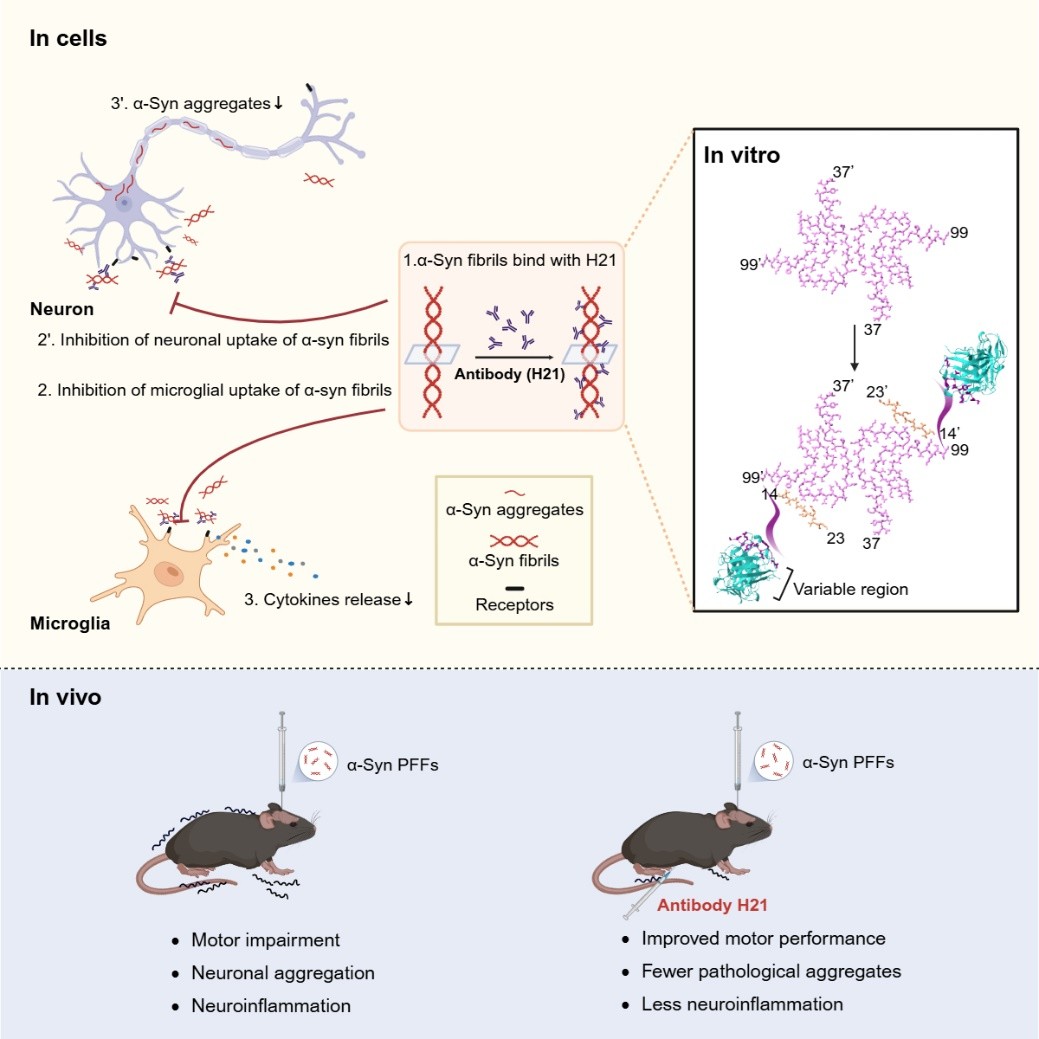
This study rationally developed a monoclonal antibody, H21, that selectively targets the pathological C-terminal epitope of α-syn fibrils and exhibits high affinity and remarkable fibril specificity toward α-syn fibrils.
In vitro functional assays demonstrated that H21 binds preferentially to the fibrillar form of α-syn at its C-terminal residues and competitively inhibits its interactions with established α-syn fibril receptors and binding partners, including FAM171A2, RAGE, LAG3, and LC3B. Structural characterization employing cryo-electron microscopy (cryo-EM) and cryo-electron tomography (cryo-ET) further revealed that H21 directly engages α-syn fibrils, assembling in a periodic arrangement on the fibril surface and inducing conformational alterations in the fibril architecture. In vivo assays showed that treatment with H21 in a PD mouse model substantially attenuated pathological α-syn spreading, reduced neuroinflammatory responses, and significantly improved motor outcomes.
This study systematically elucidated the rational design and structural characterization of H21, a fibril-specific antibody targeting the C-terminal region of α-syn fibrils. Atomic-level structural analysis provided unprecedented insights into the interaction mechanism between the antibody and amyloid fibrils. The comprehensive therapeutic efficacy demonstrated by H21 in PD mouse models indicates its potential in intervening PD-related pathological processes and further provides a scientific basis for therapeutic strategies targeting the C-terminal region of α-syn fibrils.
Mabwell has recently achieved multiple advancements in the field of neurodegenerative diseases. Its incubated company SynuSight Biotech has self-developed a high-selectivity and high-affinity PET tracer, 18F-FD4 (“FD4”), that targets α-syn pathological protein. FD4 enables the visualization and quantitative detection of α-syn pathological protein aggregation in human brain. SynuSight Biotech has entered into a non-exclusive clinical use license agreement of FD4 with ABLi Therapeutics (“ABLi”), which will utilize FD4 to evaluate the aggregation levels of α-syn pathological protein in the brains of PD patients before and after treatment with ABLi’s novel PD drug. From precision diagnosis to therapy, Mabwell continues to deepen its strategic layout in the field of age-related diseases, committed to delivering innovative solutions for patients.