Release time:Jun 03, 2026
At the 2026 American Society of Clinical Oncology (ASCO) Annual Meeting held in Chicago, USA, from May 29 to June 2, the results of the Phase Ib/II clinical study of Mabwell’s Nectin-4-targeting ADC 9MW2821(Bulumtatug fuvedotin,BFv) in combination with toripalimab for the treatment of patients with locally advanced or metastatic urothelial carcinoma (la/mUC) were presented by Prof. Guo Jun, Chief Physician of Beijing Cancer Hospital, on behalf of the research team. Result of the Phase II study of BFv in combination with toripalimab for the perioperative treatment of muscle‑invasive bladder cancer (MIBC) was presented as a poster. Both studies demonstrated encouraging efficacy and a favorable safety profile.
Oral Presentation: BFv in combination with toripalimab for the treatment of la/mUC

Background:
BFv is a next-generation Nectin-4 targeting antibody-drug conjugate with an MMAE payload. Toripalimab is a novel recombinant humanized anti-PD-1 monoclonal antibody that has been approved in China, USA and other countries. The preliminary results of BFv combined with toripalimab in treatment-naïve patients with la/mUC have been reported on ASCO 2025: confirmed ORR 80.0%; DCR 92.5%. On this meeting we will report the efficacy and safety data of overall population, including patients progressed on/after standard therapy and previously untreated for la/mUC.
Method:
This is a phase Ib/II, open-label, multicenter study of BFv and toripalimab in la/mUC in China. Every 21 days per cycle, patients received BFv (1.0 or 1.25mg/kg, on day 1 and 8) and toripalimab (240mg, on day 1). Treatment until disease progression or unacceptable toxicity. Treatment until disease progression or unacceptable toxicity.
Results:
As of Dec. 1, 2025, 52 patients with la/mUC were enrolled with the median age of 67, 71% of patients were male, 72.5% had an Eastern Cooperative Oncology Group (ECOG) score of 1, 58% with tumor primary site at upper urinary tract, 17% had liver metastases, 83% were Nectin-4 positive and 17% were PD-L1 CPS≥10. For patients with locally advanced or metastatic UC, 83% had not received prior treatment, 10% had previously progressed after receiving only platinum-based chemotherapy, 6% had progressed after prior treatment with platinum-based chemotherapy and immune checkpoint inhibitors, and 2% had progressed after prior treatment with platinum-based chemotherapy and anti-HER2 ADC.
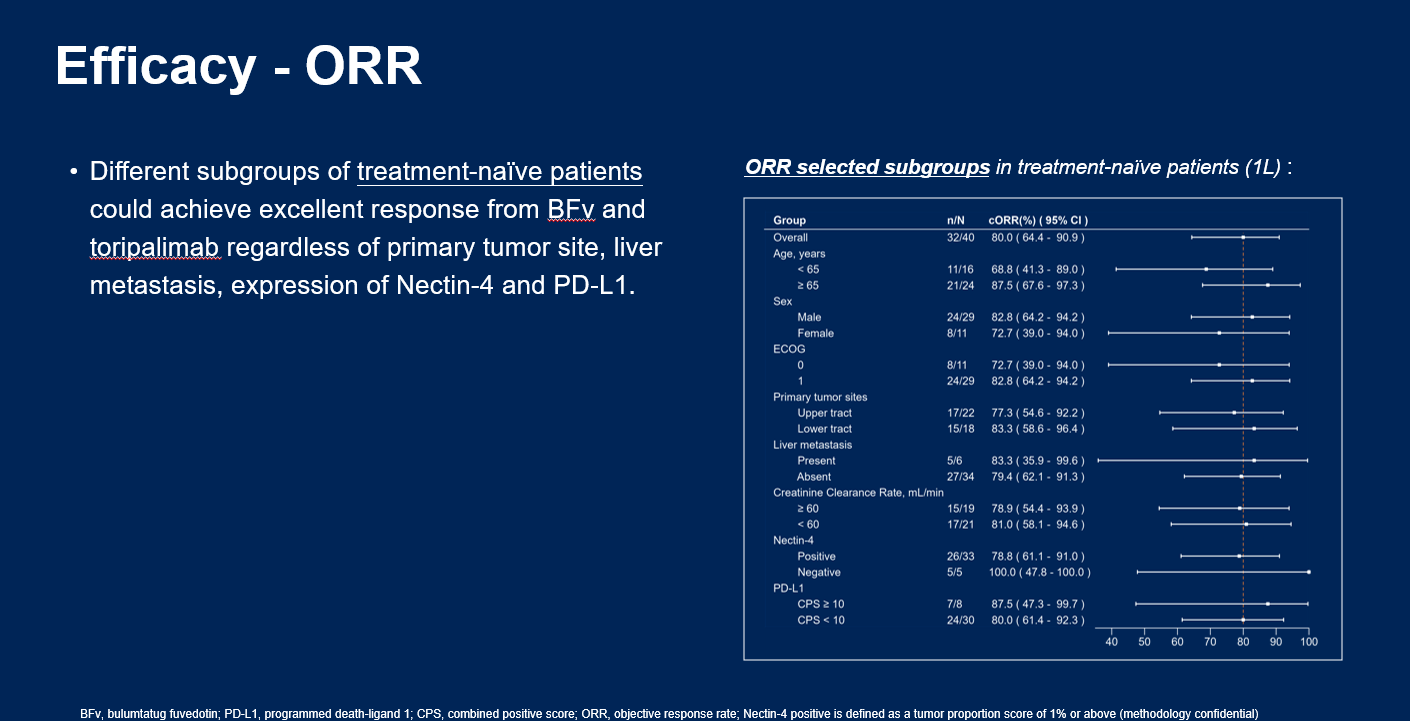
47 patients with la/mUC had at least one tumor assessment,the Objective Response Rate (ORR) was 83%, Disease Control Rate (DCR) was 89.4%. Among 40 treatment-naïve patients for la/mUC (all BFv 1.25mg/kg combination), ORR was 87.5%, DCR was 92.5%. Among previously treated patients for la/mUC (n=7; 3 pts for BFv 1.0mg/kg combination, 4 pts for BFv 1.25mg/kg combination), ORR was 57.1%, cORR was 42.9%, DCR was 71.4%:
- BFv 1.0mg/kg (n=3), all chemo progressed only, ORR 33.3%, DCR 66.7%.
- BFv 1.25mg/kg (n=4), all chemo progressed including 3 pts ICI progressed, ORR 75.0%, DCR 75.0%.
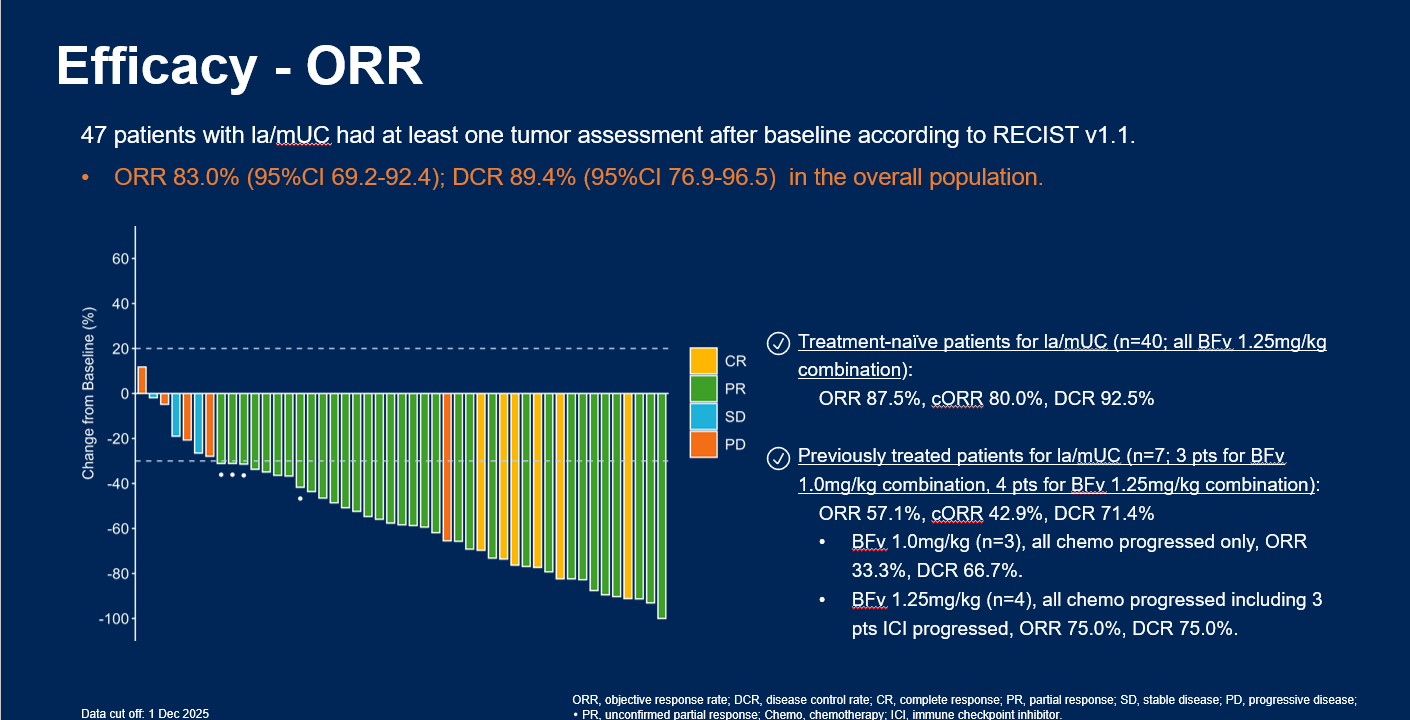
Different subgroups of treatment-naive patients could benefit from BFv and Toripalimab regardless of primary tumor site, liver metastasis, expression of Nectin-4 and PD-L1.
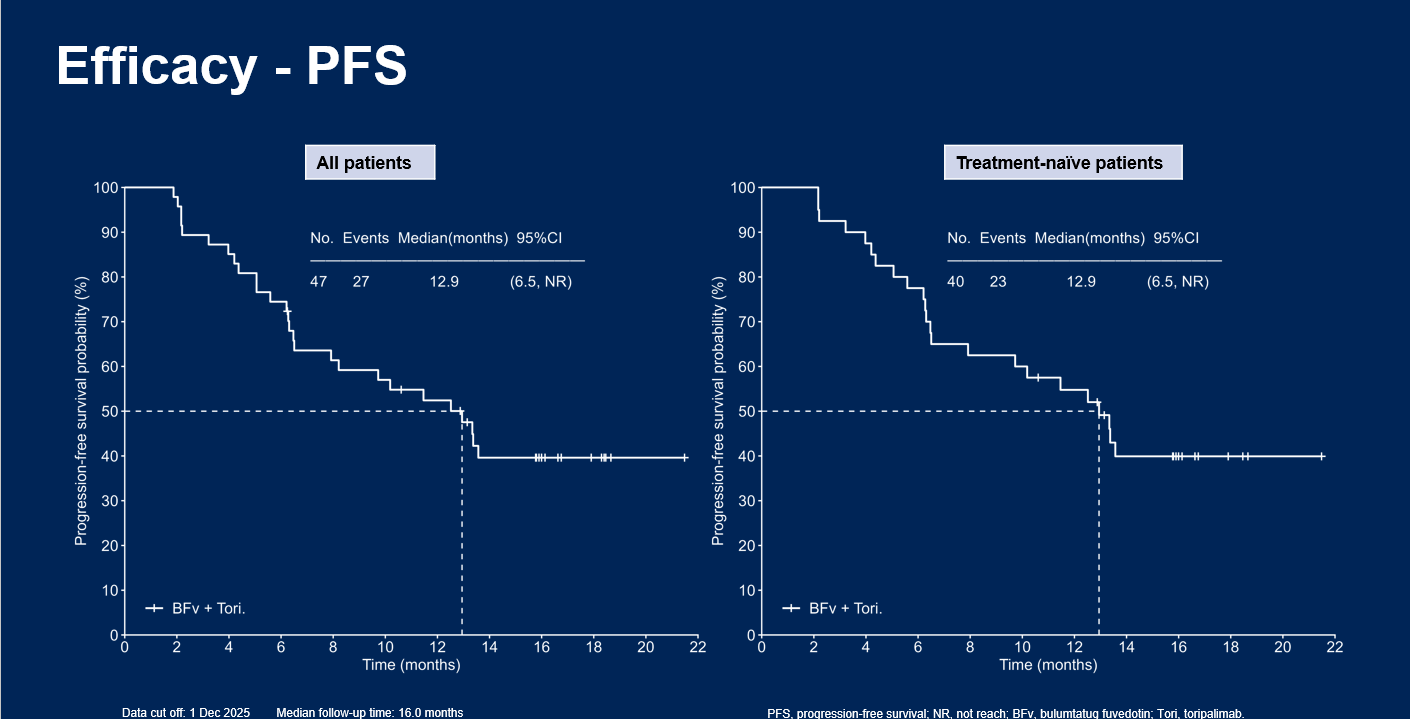
As of December 1, 2025, the median follow‑up duration was 16.0 months. The median progression‑free survival (mPFS) was 12.9 months in both the overall population and the previously untreated population. The median duration of response (mDoR) and median overall survival (mOS) have not been reached.
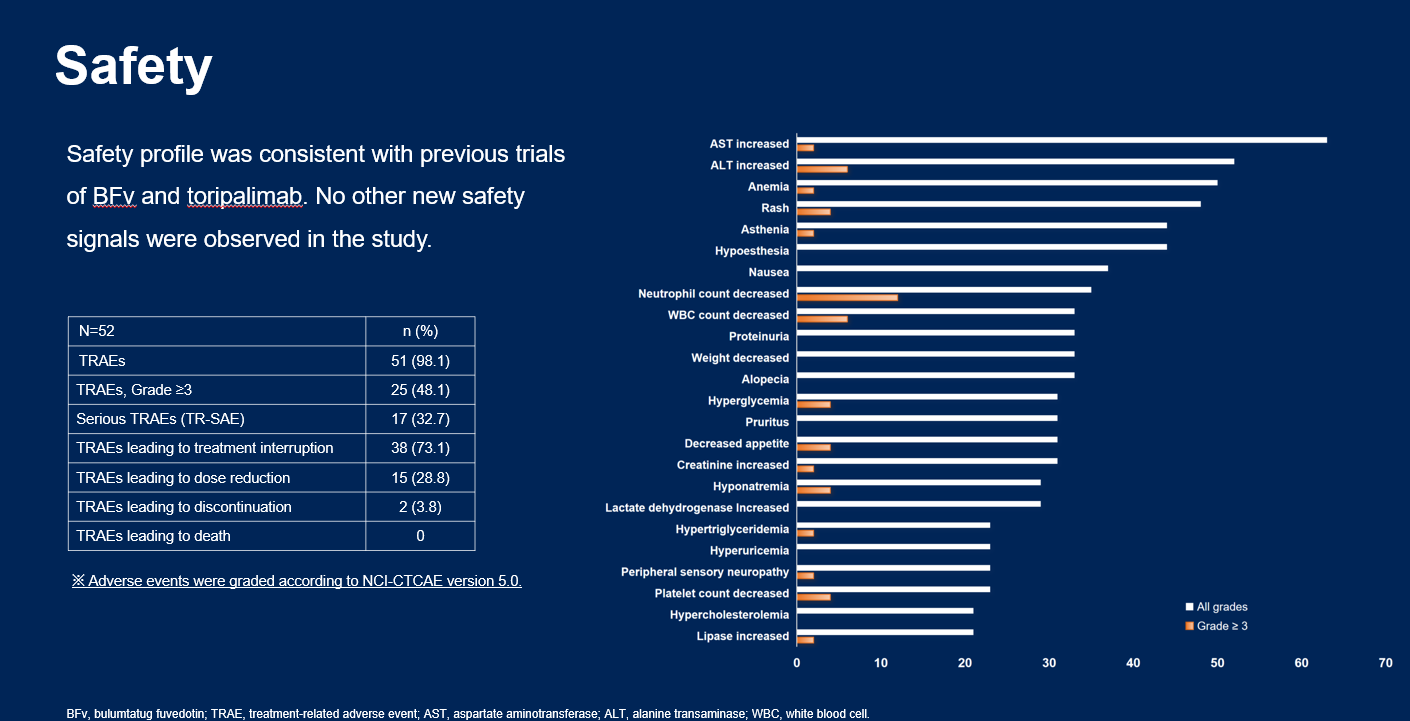
The incidence rate of treatment-related adverse events (TRAE) was 98.1%, and most of the TRAEs were grade 1-2. The incidence rate of TRAEs ≥grade 3 was 48.1%, mainly characterized by neutrophil counts decreased, alanine aminotransferase increased, and white blood cell decreased. The incidence rate of serious TRAEs was 32.7%, and no TRAEs leading to death occurred. BFv and Toripalimab showed well-tolerated safety profile. No other new safety signals of BFv or Toripalimab were observed in this study.
Conclusion:
Bulumtatug fuvedotin (BFv) plus toripalimab has demonstrated encouraging efficacy and favorable safety profile. A pivotal phase 3 study of BFv combined with toripalimab vs platinum-based chemotherapy is ongoing in China currently (NCT06592326). It is expected to get positive result and be a valuable treatment option for la/mUC.
Poster Presentation: BFv in combination with toripalimab for the perioperative MIBC
The Phase II clinical study on BFv in combination with toripalimab for patients with perioperative MIBC enrolled a total of 32 subjects. As of January 4, 2026, 7 subjects completed neoadjuvant therapy (9MW2821 in combination with toripalimab). Among these subjects, 6 subjects completed radical cystectomy and regional lymph node dissection, and 1 subject refused radical surgery due to achieving clinical CR following neoadjuvant therapy. Pathological complete response (pCR) was 66.7% (4/6), and pathological downstaging (pDS) rate was 83.3% (5/6). No new safety signals related to 9MW2821 or toripalimab were observed in this study.